Early History of OBVR

During the early 1960’s a growing concern among historical societies, government officials and history minded citizens over the loss of historic structures to the rapid suburbanization of Nassau County led to the creation of Old Bethpage Village Restoration. In June of 1962 Edward J. Smits, Nassau County Historical Museum Curator, prepares a report for the Commissioner of Public Works Eugene Gibbons proposing the acquisition and preservation of a typical Long Island farm for educational interpretation. Around the same time a property in Old Bethpage was being considered for a housing development. John Burns, the Town of Oyster Bay Supervisor, opposed the development and urged its acquisition for public park land. In 1963 Nassau County acquires the 160.5-acre site of the former Powell family farm from a private hunt club. The original Powell house, in poor condition, though still standing, provided the ideal site for Mr. Smits proposed farm restoration.
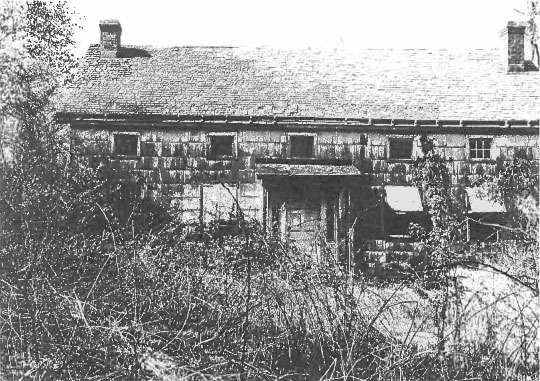
This circa 1962 photograph of the original Powell farmhouse shows what Nassau County officials first saw when considering it for preservation and as a focal point for the future Restoration Village.
Photo courtesy of Gary Hammond
The effort to develop the property was bolstered when Nassau County was offered the 1857 Plainview Methodist Church, which was in danger of being demolished, To save the church County Executive Eugene Nickerson requested a $2,000 emergency appropriation from the Board of Supervisors to move it to the County Tuberculosis Sanatorium on Round Swamp Road where it was stored until the Powell farm purchase was completed. The church along with the Bach Blacksmith shop, already in Nassau County’s possession, became the first buildings relocated to Old Bethpage.

The Plainview Manetto Hill Methodist Church on its original site.
1963 Nassau County Photo Archives Center
Where Long Island’s History Lives On
With numerous landmark buildings in danger of being lost, a set of criteria was established to determine if a building would be a viable candidate for relocation. Since the cost of research, moving, and restoration were so high every building had to be donated. Nassau County would assume the cost of moving and restoration but not for its acquisition. A building would not be considered unless every effort had been made to preserve the building on its original site or community. Old Bethpage was the place of last resort.
Several other criteria needed to be met before a final determination would be made.
- A building had to be architecturally significant. The building had to represent traditional Long Island building techniques and styles.
- The historic association of the structure. This included an analysis of the interpretive value of the building based on its original use and/or the occupants social, economic or civic role was undertaken. The building’s value as an individual structure and what it would contribute to the historical interpretation of the entire village scene was considered.
- The practicality of moving and restoring the structure. How much of the 19th century structure remained and could it withstand the move and restoration and be cost effective.
- The building was constructed prior to 1870.
1964 brought four more buildings to Old Bethpage. New York State donated the John M. Layton store and the John B Luyster store to make way for road construction on Route 25A at the Route 106 intersection in East Norwich. The Town of Hempstead donated East Meadow’s Noon Inn. The John L. Potter house from Great Neck was completely disassembled and brought to the site to be stored for future restoration. Unfortunately, the components were lost to a fire in the Storage Barn in October of 1975.

Luyster Store, East Norwich 1963
Nassau County Photo Archives Center
Turning a Vision Into Reality
It was determined early on that for the endeavor to be successful the private sector would need to be involved. Private not-for-profit support groups and average citizens would become a valuable resource. Citizen involvement was vital to acquire essential historic furnishings and also indicated to public officials evidence of strong citizen interest and support for the village. In November 1963 The Agricultural Society of Queens, Nassau, and Suffolk counties provided a founding gift of $5,000 for the restoration project. Less than 10 years later the Ag Society would partner with Nassau County to bring the Long Island Fair to Old Bethpage. The Friends of the Nassau County Historical Museum, later to become the Friends for Long Islands Heritage was formed.
In 1967 County Executive Eugene Nickerson was contacted by Lurelle Guild, a noted interior designer and author of several American antique books. Guild had acquired a vast collection of rare Early Americana antiques, which he was looking to sell. The museum’s curatorial staff visited his Noroton Connecticut site along with Preston Bassett, President of the Friends of the Nassau County Historical Museum. All were astounded by the depth of the collection. The collection was bought for $50,000 and loaded into seven large moving vans and transported to Long Island. This provided an immediate stock of furniture, craft tools and equipment, store and house contents that would otherwise be impossible to duplicate without many years of collecting. In addition, hundreds of Long Islanders, some from families of the original settlers of Nassau County, generously donated historic furniture, household items and agricultural implements for the village.
The dream was realized on June 27, 1970 when County Executive Eugene Nickerson officially opened Old Bethpage Village Restoration to the public. Although relocation and restoration work would continue into the 70s most of the village buildings were in place and open.
The source material for this page was derived from two essays. One by the late Edward J. Smits the former Nassau County Division of Museum Services Museum Director, from a draft of his first-hand account of the creation of OBVR entitled “Old Bethpage Village Restoration A Perspective on its Twentieth Anniversary.” The other an article written by Gary Hammond, a retired Museum Curator and longtime employee of the Division, for the 2021 Nassau County Historical Society Journal, Volume 76.

The Opening Day Ceremonies for OBVR on June 27, 1970 were held on the cobblestone plaza in the parking lot, opposite the Visitor Reception Center, with the entrance road in the background.
Photo courtesy of Gary Hammond

More Information & Latest Updates
For more information and the latest updates regarding the 2026 fair, please visit lifair.org